

Many Malaysian business owners have done it before.
The company needs to pay suppliers next week, but the director temporarily takes some cash out to cover personal expenses. Maybe it’s for a house renovation, a new car deposit, or simply to manage short-term cash flow.
After all, it’s your company, right?
Not exactly.
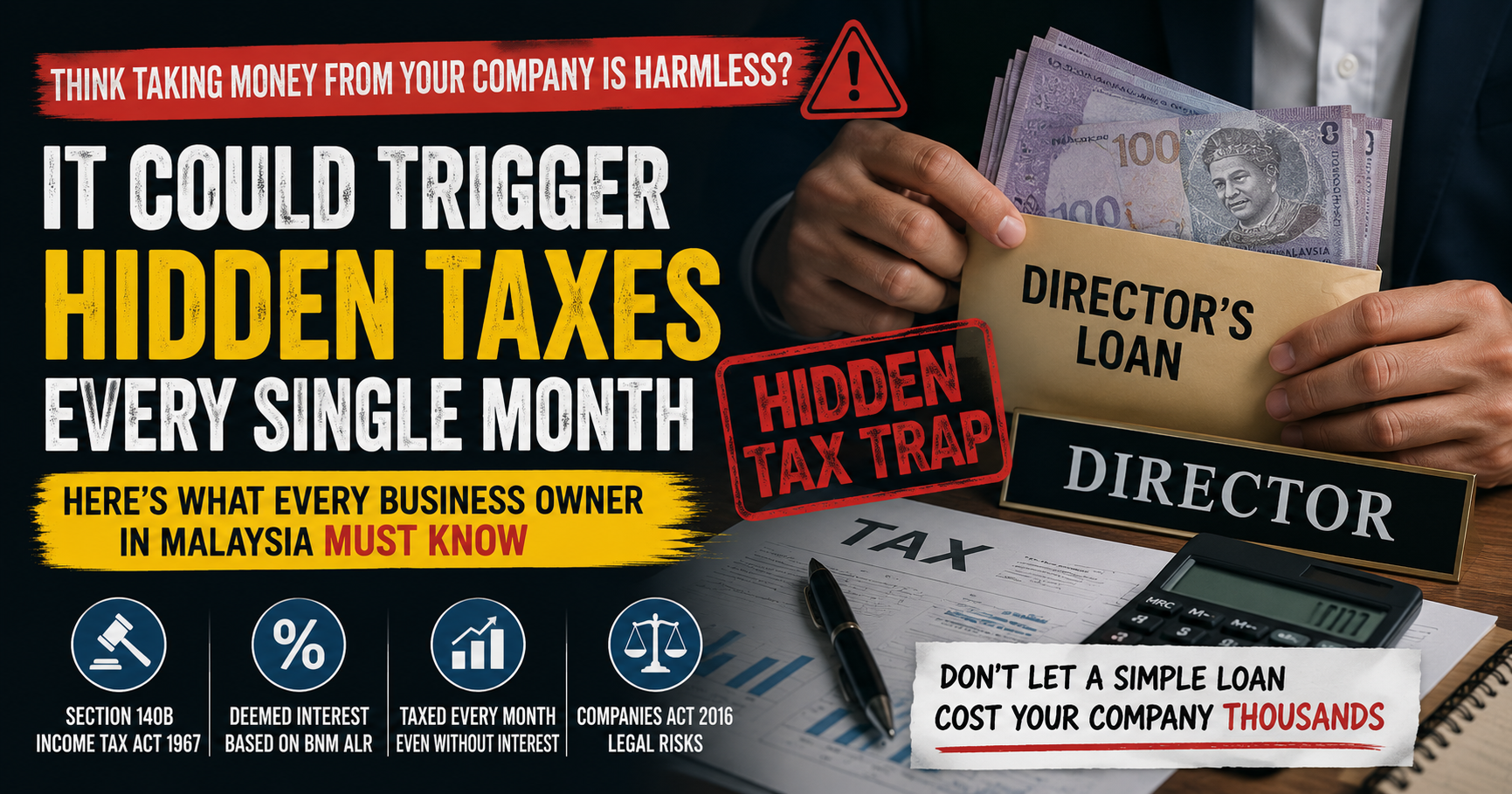
What many directors don’t realise is that taking money from the company through a director’s loan account can quietly create a tax liability for the company itself, even when no interest is charged and no actual income is earned.
Under Malaysia’s Income Tax Act 1967, what looks like a harmless internal transaction can result in deemed interest income being imposed by LHDN every single month.
What Is A Director’s Loan?
A director’s loan occurs when a company advances money to a director.
This often happens in privately owned companies where shareholders and directors are usually the same individuals.
Examples include:
- Withdrawing company funds for personal use
- Paying personal expenses using company accounts
- Taking temporary advances from the business
- Using company cash flow as a personal financing source
Many business owners assume there is no issue as long as the money is eventually repaid.
However, Malaysian tax law takes a different view.
Section 140B: The Tax Rule Many Directors Overlook
Section 140B of the Income Tax Act 1967 was introduced to prevent directors from receiving interest-free financing from companies without tax consequences.
The rule generally applies when:
- The company advances money from its own internal funds
- The recipient is a director involved in management
- The director controls at least 20% of the company’s ordinary share capital
When these conditions are met, LHDN may treat the company as having earned interest income, even if no interest was actually charged.
In simple terms, the tax authority assumes the company should have charged interest and taxes the company accordingly.
What Are Considered Internal Funds?
Many directors assume only borrowed funds are affected.
In reality, Section 140B covers advances funded by:
- Paid-up capital
- Retained earnings
- Accumulated profits
- Company reserves
- Internal cash generated from operations
If company funds are used to finance a director, the deemed interest provisions may apply.
How Does The Deemed Interest Calculation Work?
The calculation is based on Bank Negara Malaysia’s Average Lending Rate (ALR).
Each month, the outstanding loan balance is multiplied by the applicable lending rate.
The resulting amount is treated as interest income earned by the company.
For example:
Outstanding Director Loan: RM500,000
Average Lending Rate: 6%
Annual Deemed Interest:
RM500,000 × 6% = RM30,000
Monthly Deemed Interest:
RM30,000 ÷ 12 = RM2,500
This means the company may be taxed as though it earned RM2,500 in interest every month, even though no interest was received.
The longer the loan remains outstanding, the larger the deemed income becomes.
Can Companies Avoid This Tax Treatment?
Yes, but only under specific conditions.
To avoid the deemed interest provisions, the company must charge interest to the director at a rate equal to or higher than the applicable Average Lending Rate.
Charging a lower rate may not solve the problem.
If the interest charged falls below the benchmark rate, LHDN may still disregard the actual interest and apply the full deemed interest calculation.
Many SME owners are unaware of this requirement until they face a tax audit.
The Hidden Risk For Dormant Companies
Some business owners believe dormant companies are exempt from these rules.
Unfortunately, that is not always the case.
Under LHDN’s Public Ruling, a dormant company that advances money to a director may be regarded as having commenced business operations.
Once that happens, the company can become subject to the same Section 140B deemed interest rules as an active company.
A dormant company that was previously filing minimal tax returns could suddenly face unexpected compliance obligations.
It’s Not Just A Tax Issue
Beyond tax implications, directors should also be aware of the Companies Act 2016.
Section 224 places restrictions on loans made by companies to their directors.
Depending on the company’s structure and status, approvals may be required before such loans can be granted.
Failure to comply could expose directors to significant legal consequences.
For certain companies, unauthorised director loans can result in:
- Regulatory action
- Financial penalties
- Corporate governance breaches
- Criminal liability under the Companies Act
While exempt private companies enjoy certain exemptions, directors should seek professional advice before assuming a transaction is permissible.
Practical Tips For Business Owners
If you regularly withdraw company funds for personal purposes, consider the following:
Keep Personal And Company Finances Separate
The company account should not function as a personal ATM.
Monitor Director Current Accounts
Review outstanding balances regularly and avoid allowing large amounts to accumulate.
Document All Transactions
Proper resolutions, agreements, and supporting records are essential.
Consider Charging Interest
Where appropriate, charging interest may reduce exposure under Section 140B.
Seek Professional Advice Early
It is often cheaper to structure transactions correctly than to deal with tax adjustments and penalties later.
FinCrew’s Take
Director’s loans are one of the most misunderstood areas of SME taxation in Malaysia.
What appears to be a simple withdrawal of company funds can create hidden tax exposure, compliance obligations, and even legal risks.
Many business owners focus on growing revenue while overlooking the technical rules surrounding shareholder and director financing.
The reality is simple: if company money is being used for personal purposes, it is worth reviewing the arrangement before LHDN reviews it for you.
Proper planning today can help avoid unexpected tax bills tomorrow.
If you’re unsure whether your director’s loan account may trigger tax implications, obtaining professional advice early can save significant costs and headaches later.