
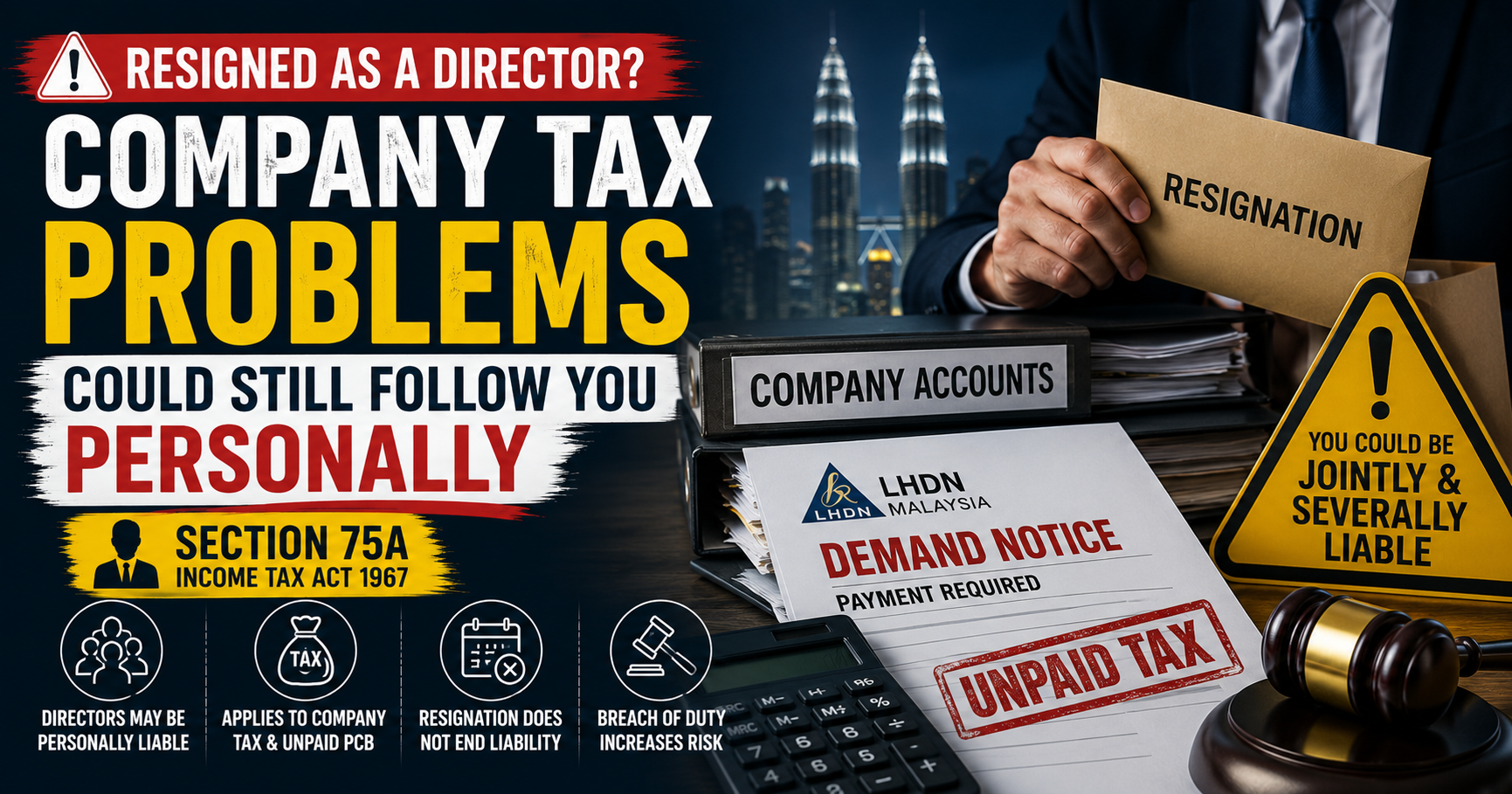

You resign as a company director. Or perhaps the business shuts down completely. You might assume that any unpaid company taxes are now the company’s problem.
In Malaysia, that assumption could become an expensive mistake.
Section 75A of the Income Tax Act 1967 allows LHDN to pursue certain company directors personally for tax that became due and payable during the relevant period.
And resigning later doesn’t necessarily erase that exposure. Here’s what Malaysian business owners and directors should know.
When Can a Director Become Personally Liable?
A Sdn Bhd is generally a separate legal entity from its shareholders and directors. But Section 75A creates an important exception when it comes to certain unpaid tax liabilities.
Where the requirements of Section 75A are satisfied, a director can be jointly and severally liable for tax that is due and payable by the company.
“Jointly and severally” is important.
It means recovery action does not necessarily have to be limited to the company alone. LHDN’s Public Ruling explains that action may be taken against the company and liable directors together, or separately against liable directors.
So in the wrong circumstances, a company tax problem can become a personal financial problem.
But Not Every Director Automatically Falls Under Section 75A
This is one of the most important details.
For Section 75A purposes, the definition of a director is more specific than simply having your name registered as a company director.
According to LHDN’s Public Ruling No. 2/2019, it covers a person occupying the position of director — including someone concerned in managing the company’s business — who also owns or controls at least 20% of the company’s ordinary share capital, either personally or together with associates.
That means the 20% threshold matters. It can also potentially capture someone actively involved in managing the business even if their job title isn’t simply “Director”, provided the statutory requirements are satisfied.
For founder-led and family businesses, this is particularly important.
What If You Resign?
Resignation is not necessarily a reset button. The key question is when the company’s tax became due and payable. If you fell within Section 75A during the relevant period, subsequently resigning from the company does not automatically make that earlier exposure disappear.
Think of it this way:
You cannot necessarily walk away from an existing tax liability simply by submitting your resignation after the problem has already arisen. This is why directors considering leaving a financially troubled company should understand its tax position before assuming their responsibilities have ended.
What About PCB Collected From Employees?
Employers have obligations to make Monthly Tax Deductions, commonly known as PCB, from employees’ remuneration and remit the required amounts to LHDN. This is money connected to employees’ income tax obligations — not additional working capital for the business.
Cash-strapped companies can get into serious trouble when statutory payments are delayed while other operating expenses are prioritised.
For directors, unpaid tax-related obligations should therefore never be treated as just another supplier bill that can indefinitely sit at the bottom of the payment list.
The 20% Rule Business Owners Should Understand
Imagine a company has three shareholders:
- Director A owns 50%.
- Director B owns 30%.
- Another shareholder owns 20%.
If tax becomes due and remains unpaid, simply saying “the debt belongs to the Sdn Bhd” may not tell the whole story.
Section 75A needs to be considered in light of each person’s position, involvement and ownership/control. The legislation also considers indirect control and associates, meaning simply splitting shares among connected parties should not be assumed to remove the issue.
This is why business owners should obtain professional advice based on their actual shareholding and management structure rather than relying on their job title alone.
Directors Have Wider Responsibilities Too
Tax liability isn’t the only issue directors need to think about.
Under Section 213 of the Companies Act 2016, directors are required to exercise reasonable care, skill and diligence in carrying out their responsibilities.
SSM specifically recognises these statutory duties as part of Malaysia’s framework governing directors.
A director therefore shouldn’t adopt the attitude:
“My accountant handles tax, so I don’t need to know anything about it.”
You don’t necessarily need to personally prepare the company’s tax returns.
But as a director, maintaining oversight of significant company obligations is good governance.
5 Things Directors Should Check Regularly
If you’re a director or substantial owner of a Malaysian company, don’t wait until an LHDN notice arrives.
Check these regularly:
- Are the company’s income tax filings up to date?
- Are tax payments being made when due?
- Is PCB being properly deducted and remitted?
- Are there outstanding LHDN notices, assessments or payment arrangements?
- If you’re resigning or closing the company, have you reviewed its outstanding tax position with your tax adviser?
Keep proper records too. Board resolutions, tax filings, payment confirmations and correspondence with advisers or LHDN may become extremely important if a dispute arises later.
“The Company Has No Money” Doesn’t Make the Problem Disappear
When businesses experience cash-flow problems, directors naturally focus on keeping operations alive.
Staff need salaries.
Suppliers need payment.
Rent is due.
Customers may be paying late.
But ignoring tax obligations can make an already difficult financial situation worse.
If your company cannot meet its tax obligations, address the problem early with your accountant, tax agent or appropriate professional adviser.
Waiting until enforcement action begins usually leaves fewer options.
Final Thoughts
One of the biggest misconceptions about running a Sdn Bhd is that every company debt automatically stays inside the company forever.
Section 75A shows why directors and business owners shouldn’t make that assumption when it comes to tax.
Certain directors meeting the statutory requirements can be personally exposed to company tax that became due and payable during the relevant period — and resigning later does not necessarily make that historical exposure disappear.
The practical lesson is simple:
Before resigning, winding down a company or ignoring an outstanding tax issue, understand exactly what the company owes and whether Section 75A could apply to you personally.
A tax problem left inside your company today could eventually arrive with your own name on it.
Disclaimer: This article is for general educational purposes only and does not constitute legal, accounting or tax advice. Section 75A liability depends on the facts and applicable law. Directors and business owners should obtain advice from a qualified tax agent, accountant or lawyer regarding their individual circumstances.