

Ask Malaysian homebuyers whether they prefer freehold or leasehold property and you’ll probably hear the same answer:
“Freehold, of course.”
It sounds logical.
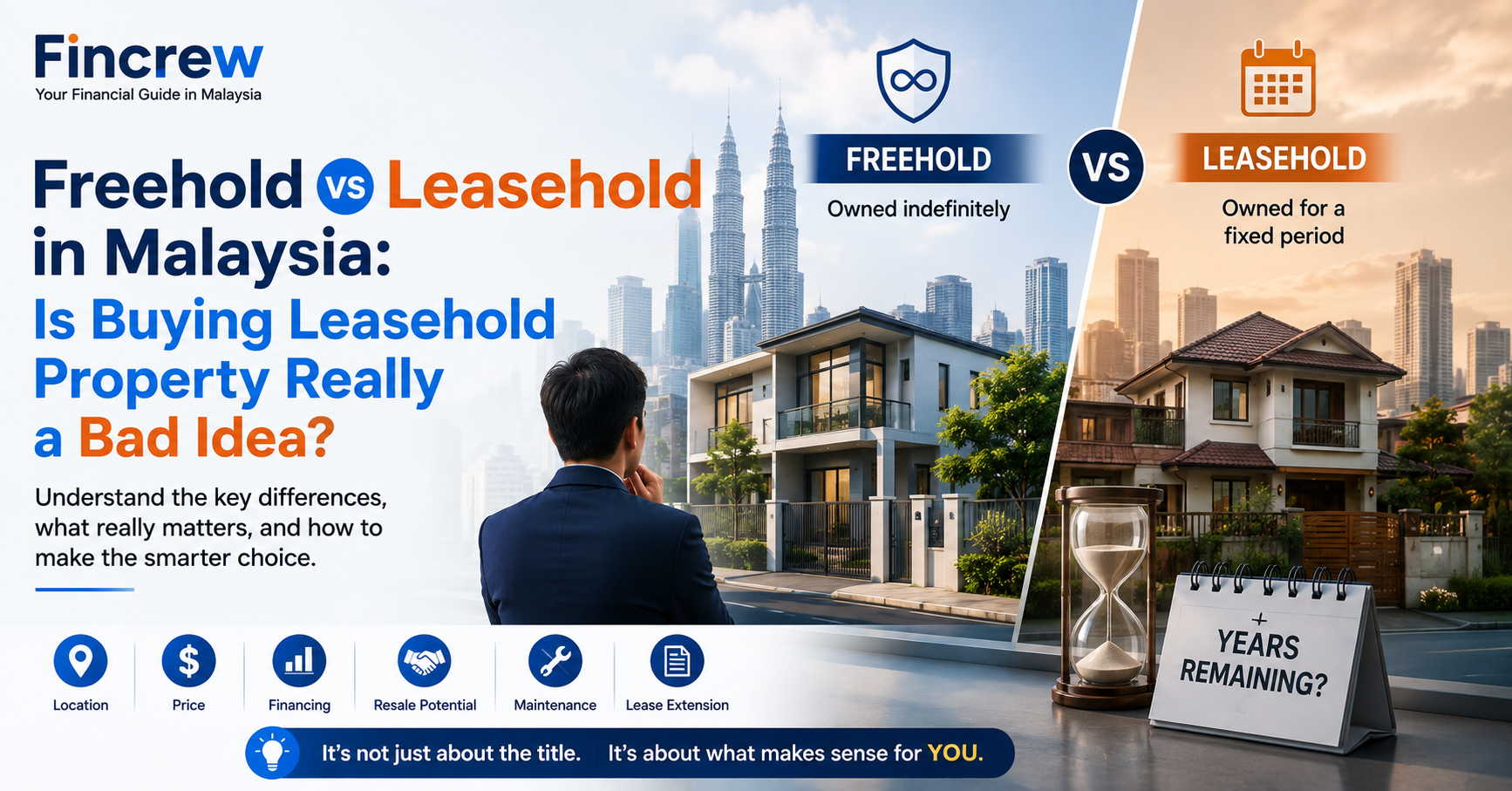
Freehold means you own the property indefinitely, while leasehold comes with an expiry date.
But does that automatically make every freehold property a better purchase?
Not necessarily.
If you’re buying a home in Malaysia, the difference between freehold and leasehold matters — but location, price, remaining lease, financing and future resale potential can matter just as much.
Here’s what you should understand before deciding.
What Is a Freehold Property?
Freehold generally means the land is held without a fixed expiry date.
This is one reason freehold properties are attractive to Malaysian buyers.
There isn’t a 99-year clock constantly counting down, which can provide greater certainty for people planning to hold a property for decades or eventually pass it to their children.
But there’s an important misconception:
Freehold does not mean you can do absolutely anything you want with the property.
The title can still contain conditions, restrictions and other registered interests.
You should always check the actual land title instead of relying purely on the word “freehold” in a property advertisement.
What Is a Leasehold Property?
Leasehold means the land is held for a specified period.
In Malaysia, you’ll commonly encounter leases of up to 99 years.
The important number isn’t simply:
“99 years.”
It’s how many years are LEFT when you’re buying.
Imagine a property originally came with a 99-year lease.
If you’re buying it 20 years later, approximately 79 years may remain.
Buy it much later and the remaining lease becomes increasingly important.
That’s why two leasehold properties can have very different risk profiles.
One might have more than 90 years remaining.
Another might have only 50.
Calling both simply “leasehold” doesn’t tell you enough.
What Happens When the Lease Gets Shorter?
This is where buyers should pay attention.
As the remaining lease declines, several practical issues can potentially become more significant.
The property may become less attractive to future buyers.
Financing may become more difficult depending on the bank’s requirements, the purchaser’s age, the loan tenure and the remaining lease.
And buyers may begin factoring the cost and uncertainty of extending the lease into the price they’re willing to pay.
This doesn’t mean a leasehold property suddenly becomes worthless after hitting a particular number of years.
But the remaining tenure becomes increasingly important as the lease gets shorter.
If you’re considering an older leasehold property, ask about the remaining lease BEFORE becoming emotionally attached to the unit.
Can You Extend a Leasehold Title?
Potentially, yes.
But don’t assume the extension is automatic or free.
Land matters in Peninsular Malaysia fall under the relevant State Authority, and procedures and premiums can differ between states.
An owner may be able to apply for an extension before expiry, subject to approval and the applicable premium and conditions.
This means you should be careful when someone tells you:
“Don’t worry. Can renew one.”
The better questions are:
Has anyone in this development successfully extended the lease?
What is the applicable state procedure?
How would the premium be calculated?
Has an application already been made?
Never price a property based on the assumption that a future lease extension will definitely be cheap or automatically approved.
Is Freehold Always More Expensive?
Not necessarily.
Tenure is only one component of property value.
Consider two condominiums.
Property A is freehold but located far from public transport, employment centres and major amenities.
Property B is leasehold but sits beside an MRT station in a mature neighbourhood with strong demand.
Which one would buyers prefer ten years from now?
There isn’t a universal answer.
Property values are influenced by factors including:
- Location
- Accessibility
- Nearby infrastructure
- Supply and demand
- Property condition
- Development quality
- Maintenance
- Rental demand
- Remaining lease
- Future development in the area
A freehold title cannot rescue a property nobody wants to live in.
Likewise, being leasehold doesn’t automatically make a well-located property unattractive.
What About Selling a Leasehold Property?
Leasehold properties can absolutely be bought and sold.
However, some titles contain restrictions in interest that require State Authority consent before a transfer can proceed.
This can add another administrative step to the transaction.
JKPTG confirms that where land has a restriction in interest, State Authority consent must be obtained for the transfer.
But buyers shouldn’t automatically assume every leasehold property has exactly the same restriction.
Check the actual title.
This is another reason your lawyer’s title search is important before completing a property purchase.
What About Bank Loans?
This becomes particularly important with older leasehold properties.
Banks don’t only look at your salary and credit profile when deciding whether to finance a property.
They also evaluate the property being used as security.
A property with a long remaining lease may present a very different financing situation from one approaching the later stages of its tenure.
Individual banks can have different lending policies.
Therefore, if you’re considering an older leasehold property, speak with banks or a mortgage adviser early instead of assuming you’ll automatically receive the maximum loan tenure.
When Could Leasehold Actually Make Sense?
Leasehold shouldn’t automatically be removed from your property search.
It may still make sense when:
The location is significantly better.
The purchase price represents good value.
There is still a long lease remaining.
Rental demand is strong.
The development is well maintained.
You’re buying primarily for your own occupation rather than planning to hold it across generations.
For example, choosing a well-connected leasehold condominium 10 minutes from your workplace may make more financial and lifestyle sense than buying a freehold property much farther away simply because it says “freehold”.
When Might Freehold Be More Attractive?
Freehold may deserve additional consideration when you’re planning to hold the property for a very long time.
It can be particularly attractive if:
You intend to pass the property to your children.
You’re comparing two otherwise similar properties.
You’re uncomfortable with future lease-extension uncertainty.
You’re purchasing land for long-term family ownership.
Again, that doesn’t automatically make the freehold property the better deal.
Price and location still matter.
5 Things to Check Before Buying a Leasehold Property
Before paying the booking fee, find out:
- How many years remain on the lease?
Don’t rely on the project’s age. Check the title information. - Are there restrictions in interest?
Find out whether State Authority consent is required for transfer. - Will your bank finance it?
Check financing options before committing, particularly for older properties. - What is happening to property values in the area?
Compare similar freehold and leasehold transactions where possible. - What is the state’s lease-extension process?
If the remaining tenure is becoming shorter, understand the procedure rather than assuming renewal will be simple.
So, Freehold or Leasehold?
If two properties were identical in every possible way — same location, price, size, condition and accessibility — many buyers would understandably choose freehold.
Real life rarely gives you that choice.
Usually you’re comparing something like:
Freehold + farther location + higher price
against
Leasehold + better location + lower price.
That’s when the decision becomes more interesting.
Don’t buy a bad property simply because it’s freehold.
And don’t reject a good property simply because it’s leasehold.
Understand exactly what you’re buying.
Final Thoughts
Freehold versus leasehold isn’t as simple as “good versus bad”.
Freehold provides indefinite tenure and removes the issue of a declining lease.
Leasehold comes with a fixed tenure, making the remaining number of years increasingly important as the property ages.
But tenure is only one part of a property decision.
A good home purchase should consider location, affordability, financing, maintenance, accessibility, future demand and your intended holding period alongside the title.
Before buying any property, check the actual title and understand its conditions and restrictions.
Because the best property isn’t necessarily the one with the word “freehold” on the advertisement.
It’s the one that makes sense for your finances, lifestyle and long-term plans.
Disclaimer: This article is provided for general educational purposes and does not constitute legal, property investment or financial advice. Land rules and procedures may vary between states. Sabah and Sarawak have separate land legislation from the National Land Code applicable in Peninsular Malaysia. Buyers should obtain professional legal and financial advice before purchasing property.