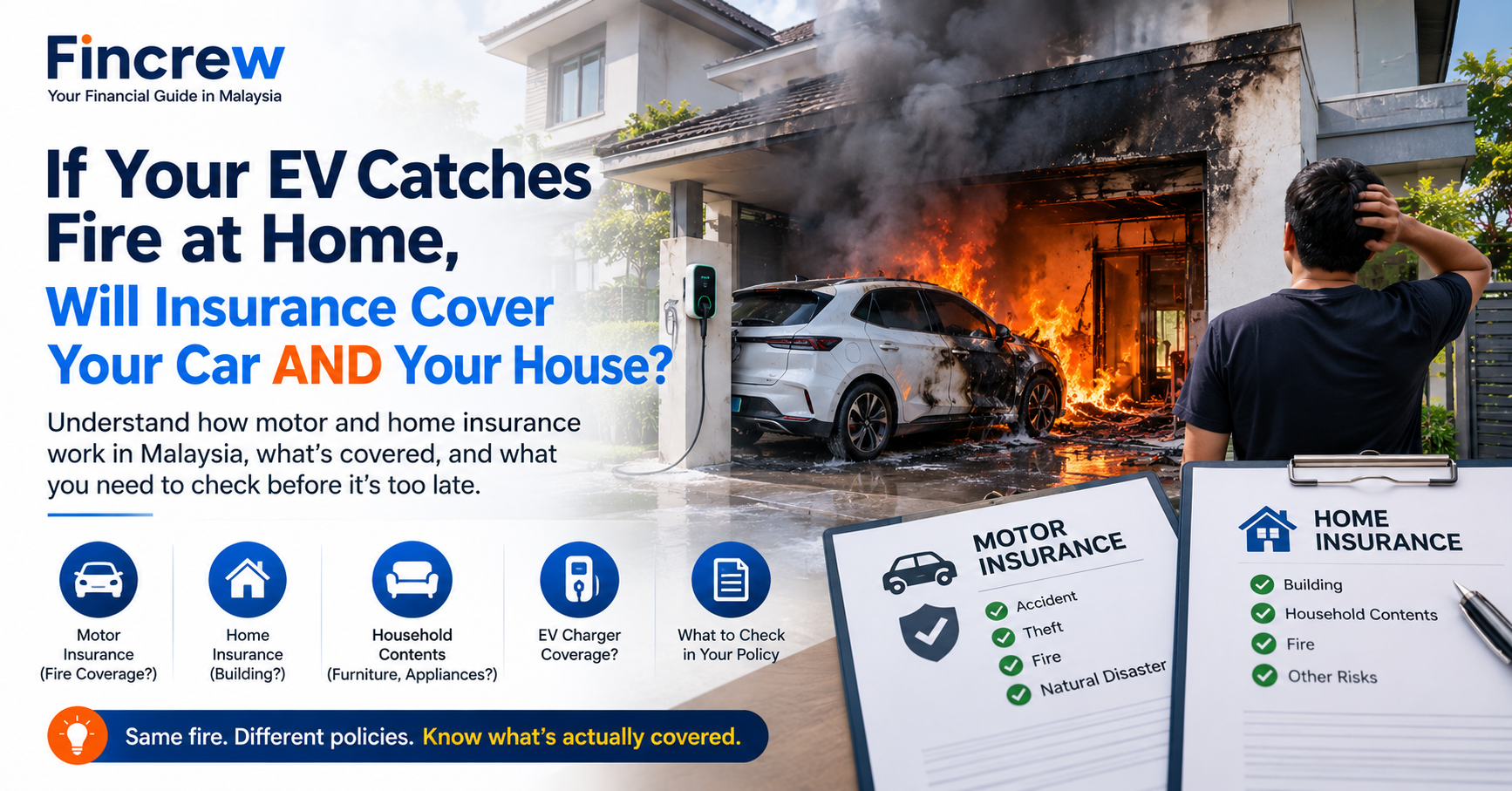

An electric vehicle catches fire while parked at home.
The vehicle is badly damaged.
The fire spreads to the porch.
Then to the house.
Furniture, appliances and personal belongings are damaged too.
You have motor insurance, so everything should be covered… right? Not necessarily.
A recent EV fire at a house in Alam Damai, Cheras has brought an important insurance question into focus for Malaysian homeowners:
If a vehicle fire damages both your car and your home, which insurance policy actually pays? The answer depends on what was damaged and, more importantly, what insurance policies you actually have.
One Fire Can Involve Several Different Insurance Policies
When people hear “fire”, they may assume one insurance policy covers the entire incident. Insurance generally doesn’t work that way. Your car, your house structure and the belongings inside your house can be insured under different policies.
A single fire could therefore involve:
- Motor insurance
- Fire insurance
- Homeowner insurance
- Householder insurance
Understanding the difference becomes especially important as more Malaysians park and charge EVs at home.
What Happens to the EV?
Let’s start with the vehicle.
PIAM explains that comprehensive motor insurance provides protection for your own vehicle against risks including accidents, theft and fire. Third Party, Fire and Theft coverage can also provide protehttps://www.fincrew.my/en/auto-insurance.htmlction when the insured vehicle is damaged by fire or stolen. However, basic third-party insurance is different. Its primary purpose is covering liability for injury, death or property damage involving third parties.
So if you’re worried about your own vehicle being destroyed by fire, don’t simply ask:
“Do I have car insurance?”
Ask:
“What type of motor insurance do I have?”
That distinction could make a very large financial difference.
What If the Fire Spreads to Your House?
This is where your motor policy and property insurance need to be distinguished. Your motor insurance is designed around the vehicle. Damage to the house itself generally falls into the property insurance side of the equation, subject to the specific policy’s coverage, conditions and exclusions.
PIAM identifies several types of property protection available in Malaysia. Basic fire insurance provides fundamental protection against specified fire-related risks. A homeowner policy is designed to protect the physical residential building against insured risks. So if a vehicle fire spreads and damages your porch, walls, roof or other parts of the building, the relevant home or fire policy may become important.
Again, coverage isn’t automatic simply because a fire occurred. The actual policy wording matters.
What About Your Furniture, TV and Other Belongings?
Here’s another common misunderstanding. Insuring the building doesn’t necessarily mean everything inside it has the same protection. Think of your home as two separate things.
First, there’s the building itself. Then there are the things you put inside it.
- Your sofa.
- Television.
- Computer.
- Furniture.
- Clothing.
- Appliances.
- And other personal possessions.
A householder policy is generally designed to protect household contents and personal belongings against insured events. This means homeowners should understand whether they have protection for:
- The building
- The contents
Having one does not necessarily mean you automatically have the other.
What About Your Home EV Charger?
This is where EV ownership creates another interesting question. Many Malaysian EV owners now have wallboxes or charging equipment installed at home. If a fire damages the charger, don’t automatically assume the motor policy will pay simply because the equipment is used to charge your vehicle. How permanently installed charging equipment is treated may depend on the wording and scope of the relevant insurance policy.
EV owners should therefore ask their insurer directly whether their home charging equipment is covered under their existing protection and under what circumstances. It’s much better to ask this while renewing your policy than after a fire.
Does Home Insurance Automatically Cover Every Fire?
No.
Insurance policies contain terms, conditions, limits and exclusions. PIAM specifically advises consumers to read policy exclusions and understand what is and isn’t covered. Different property products can also provide different levels of protection.
A basic fire policy, for example, shouldn’t automatically be assumed to provide exactly the same protection as a broader homeowner policy. Optional extensions may also be needed for certain risks. This is why comparing insurance based only on premium can be misleading. The cheapest policy isn’t necessarily the policy providing the protection you thought you were buying.
Don’t Confuse Market Value With Rebuilding Cost
There’s another important home insurance concept many homeowners overlook. When deciding how much to insure your house for, the figure shouldn’t simply be the property’s current selling price.
PIAM advises homeowners to consider rebuilding cost rather than market value when determining the sum insured. Imagine your house is worth RM800,000 on the property market.
Part of that value comes from the land and location. If the building is destroyed, you’re not buying the land again. You’re rebuilding the physical structure.
Having an appropriate sum insured matters because under insurance can leave homeowners funding part of a major loss themselves.
“My Bank Already Bought Insurance for My House”
If you have a housing loan, your bank may require property insurance as part of the financing arrangement. But don’t stop there. Find out exactly what the policy covers.
Ask whether it protects:
- The building
- Household contents
- Fire damage
- Other relevant risks
- Temporary accommodation
- Personal liability
Your bank requiring insurance doesn’t automatically mean every asset in your home is protected against every possible event. Know what you’ve actually purchased.
What Should You Do After a Serious Fire?
Your first priority should always be personal safety and contacting the emergency services. Once it is safe to deal with insurance matters, notify the relevant insurer as soon as possible. Depending on the damage, that could mean contacting both your motor insurer and your home insurer. Document the damage with photographs and videos where safe to do so.
Keep receipts and relevant documents. Avoid disposing of damaged property or beginning major repairs before speaking with the insurer unless necessary for safety or preventing further loss. PIAM has previously advised policyholders affected by major fire incidents to contact their insurers promptly because coverage and claims requirements can vary between policies.
5 Questions EV Owners Should Ask Their Insurer
If you own an EV and charge it at home, your next insurance renewal is a good opportunity to ask:
- Is my EV covered against fire under my motor policy?
- Is my house adequately insured against fire?
- Are my household contents insured separately?
- Is my home EV charger covered?
- Is my property’s sum insured sufficient to cover current rebuilding costs?
Don’t wait until something catches fire to find out the answers.
This Isn’t Only an EV Issue
It’s important not to turn every EV fire into an argument that electric vehicles are inherently unsafe. From an insurance perspective, the broader lesson applies to any serious vehicle or household fire.
A petrol or diesel vehicle can catch fire too.\
Electrical faults can start house fires.
Kitchen accidents happen.
Neighbouring fires can spread.
Unexpected events are exactly why insurance exists. The important question isn’t simply what caused the fire. It’s whether you’ve arranged the right protection for the different assets that could be affected.
Final Thoughts
The Alam Damai incident is a useful reminder that owning motor insurance doesn’t necessarily mean your entire home is protected if a vehicle fire spreads. Your vehicle, building and household belongings may each fall under different types of insurance protection. For Malaysian EV owners, there’s now another item worth checking: the home charging equipment.
Instead of asking:
“Am I insured?”
Ask:
“What exactly is insured?”
- Check your motor policy.
- Check your home policy.
- Check whether your contents are covered.
- Check your sum insured.
And understand the exclusions before you need to make a claim. Because after a major fire, finding out that you had the wrong type of insurance is already too late.
Disclaimer: This article is for general educational purposes only and does not constitute insurance or financial advice. Insurance coverage depends on the individual policy, insurer, insured event, exclusions, endorsements and circumstances of a claim. Policyholders should refer to their policy wording or speak with their insurer or licensed insurance intermediary for confirmation of coverage.