
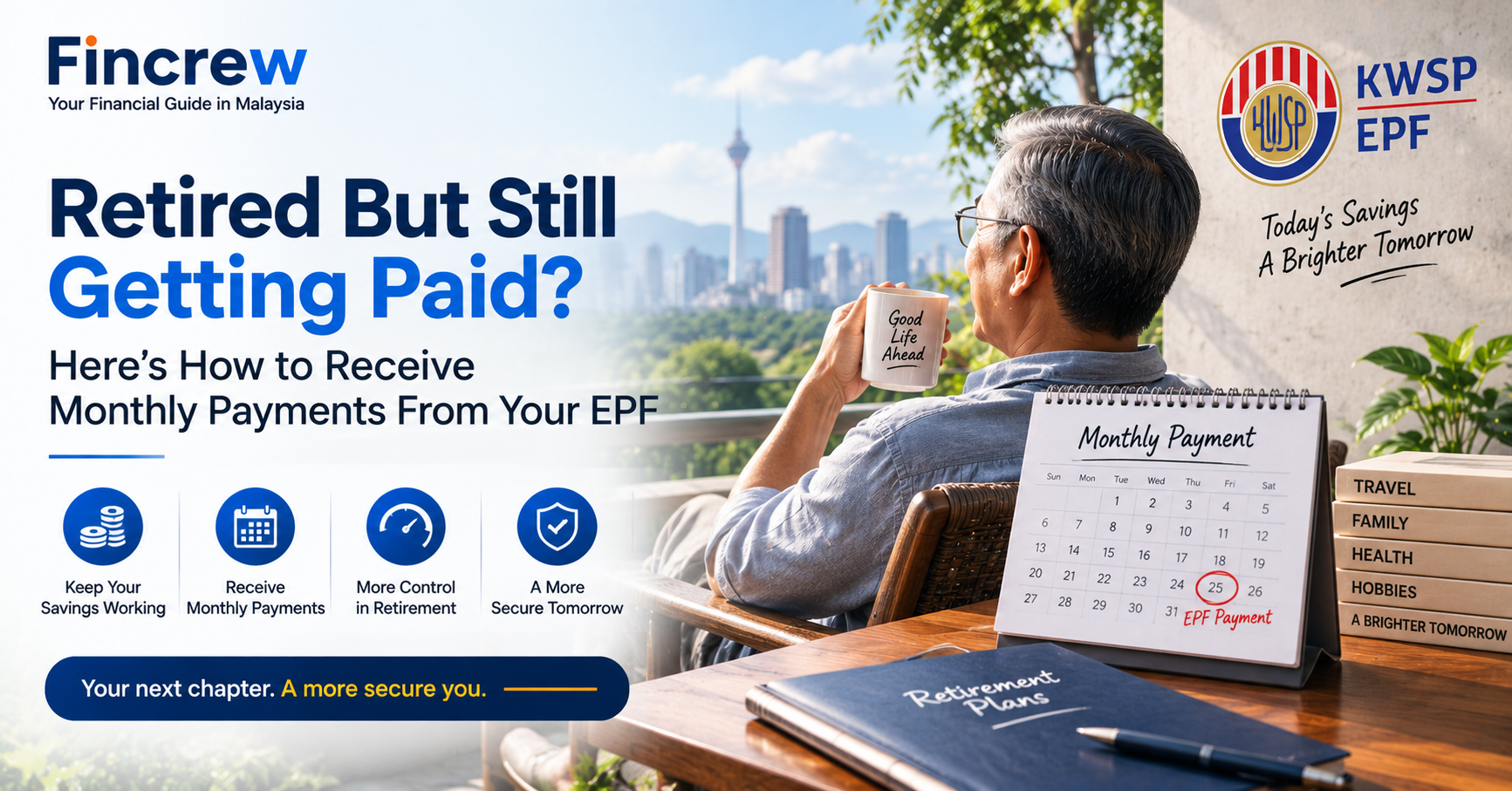

For many Malaysians, turning 55 comes with a financial moment they have waited decades for: access to their EPF savings.
Imagine opening your i-Akaun and seeing RM500,000 available in Akaun 55. You could withdraw the whole amount, transfer it into your bank account and finally have full control over the money.
New car? Renovation? Travel? Help the children? Invest somewhere else?
Or you could do something much less exciting: leave most of it in EPF and pay yourself a monthly “salary”.
EPF now calls this monthly withdrawal option i-Emas. It isn’t a new investment product; it’s the new name introduced in April 2026 for EPF’s existing Age 55/60 monthly payment withdrawal method, designed to encourage more structured retirement income. (EPF)
So which approach makes more sense?
What Actually Happens to Your EPF at 55?
When you reach 55, the savings in your Akaun Persaraan, Akaun Sejahtera and Akaun Fleksibel are combined into Akaun 55.
You then have several choices. You can withdraw everything, take only part of the money, receive monthly payments through i-Emas, or even combine a partial lump-sum withdrawal with monthly payments. (EPF)
If you continue working after 55, new EPF contributions don’t go into Akaun 55. They go into Akaun Emas, which generally becomes available for withdrawal when you reach 60. (EPF)
That flexibility is important because reaching 55 doesn’t mean you have to empty your EPF account.
What Is i-Emas?
Think of i-Emas as turning part of your accumulated EPF savings into your own retirement paycheck.
You decide on a monthly withdrawal amount and EPF credits it into your bank account each month. The current minimum is RM100 per month or RM1,200 per year, with payments lasting at least 12 months and potentially continuing until age 100, subject to your available savings. Monthly payments are generally credited on the 25th. (EPF)
The interesting part is what happens to the money you don’t withdraw.
Instead of moving your entire retirement fund into an ordinary bank account on your 55th birthday, the remaining savings stay inside EPF.
That creates a very different retirement strategy.
Let’s Say You Have RM500,000
Here are four ways someone could approach the same RM500,000:
| Strategy | Take Out Immediately | Monthly Income | Initially Left in EPF |
|---|---|---|---|
| Withdraw everything | RM500,000 | None | RM0 |
| i-Emas RM2,000/month | RM0 | RM2,000 | RM500,000 before monthly withdrawals |
| i-Emas RM3,000/month | RM0 | RM3,000 | RM500,000 before monthly withdrawals |
| Hybrid approach | RM100,000 | RM2,000/month | RM400,000 before monthly withdrawals |
These aren’t recommendations. They simply show how differently the same retirement savings can be managed.
Ignoring future dividends for a moment, RM500,000 divided by RM2,000 per month represents about 20.8 years of withdrawals. At RM3,000 per month, it represents about 13.9 years.
But reality isn’t quite that simple because money remaining in EPF can continue participating in EPF’s annual dividend declarations. Actual longevity would therefore depend on future dividends, withdrawal amounts and any other withdrawals made along the way.
The Danger Isn’t Necessarily a Bad Investment
One of the biggest risks of withdrawing RM500,000 at once may simply be having RM500,000 sitting within easy reach.
Suddenly a RM120,000 car doesn’t feel unreasonable.
RM50,000 for renovation seems manageable.
RM30,000 for a family member doesn’t look like much compared with RM500,000.
A few holidays, some gifts to the children and one unsuccessful investment later, and a retirement fund accumulated over 30 years can shrink surprisingly quickly.
That’s the behavioural advantage of monthly withdrawals. Instead of seeing yourself as someone with RM500,000 available to spend, you start thinking more like a retiree receiving RM2,000 or RM3,000 each month.
It creates a budget automatically.
That is also consistent with EPF’s stated purpose for i-Emas: encouraging structured and disciplined withdrawals so members can better sustain their savings throughout retirement. (EPF)
But Withdrawing Everything Isn’t Automatically Wrong
There are perfectly legitimate reasons someone might want a larger lump sum.
Perhaps you have an expensive loan you want to settle before retirement. You may have a genuine medical need, want to restructure your investments, or already have substantial retirement income from other sources.
The issue isn’t whether withdrawing RM500,000 is “bad”.
It’s whether you have a plan for the RM500,000 after it leaves EPF.
If you’re withdrawing everything simply because “I’m 55 now, so I can”, that’s very different from withdrawing it as part of a carefully considered retirement strategy.
The Hybrid Option May Be More Interesting
You don’t actually have to choose between “take everything” and “take nothing.”
EPF officially allows members to combine i-Emas monthly payments with a partial withdrawal. (EPF)
Suppose you retire with RM500,000. You might decide that you genuinely need RM80,000 or RM100,000 upfront to clear commitments, renovate your home and establish an emergency reserve.
Instead of withdrawing the remaining RM400,000 too, you could potentially leave it in EPF and arrange monthly withdrawals.
You get your lump sum.
You still have monthly retirement cash flow.
And you avoid placing your entire retirement savings into your everyday bank account on Day One.
For some retirees, that middle ground may be easier to manage psychologically.
How Much Should Your Monthly “Salary” Be?
This is the more important question.
If you have RM500,000 and immediately decide, “Great, I’ll pay myself RM5,000 every month,” you’re withdrawing RM60,000 a year before considering any other withdrawals.
Ignoring dividends, RM500,000 would cover only around 8.3 years at that rate.
At RM2,000 per month, you’re withdrawing RM24,000 annually. At RM3,000, it’s RM36,000.
| Starting EPF | Monthly Withdrawal | Annual Withdrawal | Years if There Were No Future Returns |
|---|---|---|---|
| RM500,000 | RM2,000 | RM24,000 | 20.8 years |
| RM500,000 | RM3,000 | RM36,000 | 13.9 years |
| RM500,000 | RM4,000 | RM48,000 | 10.4 years |
| RM500,000 | RM5,000 | RM60,000 | 8.3 years |
Again, this simplified table deliberately ignores future dividends and other changes. Its purpose is to demonstrate how dramatically your chosen monthly lifestyle affects how long your savings could last.
Retirement planning isn’t only about how much you’ve accumulated.
It’s about how quickly you spend it.
What About Someone With RM200,000?
This is where monthly planning becomes even more important.
At RM2,000 per month, RM200,000 represents only about 8.3 years before considering future returns.
If you retire at 55, that takes you only into your early 60s under that simplified calculation.
That’s why treating your EPF balance as a sudden windfall can be dangerous. The number may look large when viewed as a lump sum, but it can look very different when converted into decades of monthly living expenses.
RM300,000 sounds substantial.
RM300,000 spread across 25 years is only RM1,000 per month before considering returns.
The perspective changes completely.
Don’t Forget Inflation
There’s another problem.
RM2,000 today won’t necessarily buy the same amount of groceries, healthcare, utilities and other necessities 15 or 20 years from now.
That means simply selecting RM2,000 per month and forgetting about your retirement plan forever isn’t ideal either.
Your retirement income strategy should be reviewed periodically as your expenses, health, other income and remaining savings change.
EPF itself has increasingly emphasised retirement adequacy and sustainability, rather than simply accumulating a big balance and withdrawing it at retirement. (EPF)
The Fincrew Take
Reaching 55 doesn’t mean you suddenly need to withdraw your EPF.
The more useful question is:
What do I want this money to do for the next 20 or 30 years?
If you have RM500,000, taking the entire amount gives you maximum flexibility — but also maximum responsibility for managing it.
Using i-Emas can turn your savings into a predictable monthly income while keeping the remaining money within EPF. And the hybrid option lets you take some cash upfront without moving your entire retirement fund out at once.
There is no single answer that works for everyone.
But before clicking Full Withdrawal, try one calculation first.
Take your EPF balance and divide it by the number of months you realistically expect it to support you.
Suddenly, RM500,000 may not look like RM500,000 anymore.
It looks like your salary for the next chapter of your life.
Disclaimer: This article is for general educational purposes only and does not constitute financial or retirement advice. EPF withdrawal rules and features may change. Actual retirement outcomes depend on future dividends, inflation, withdrawals, expenses and individual circumstances. Check the latest information directly with EPF before making a withdrawal decision.