
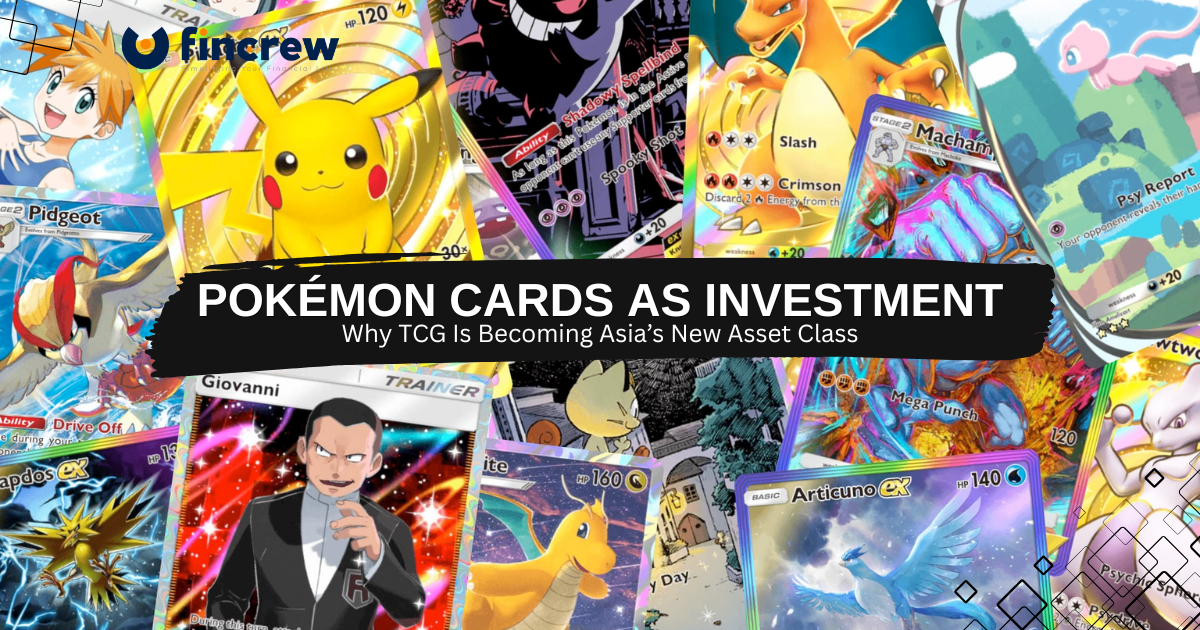

Not long ago, Pokémon cards were something you traded in school.
Today, they are being auctioned for millions of dollars, stored in vaults, and even turned into investment funds.
What was once a childhood hobby is now evolving into a legitimate alternative asset class — and Asia is playing a major role in that transformation.
A US$16.5 Million Card Changed Everything
In early 2026, a PSA 10 Pikachu Illustrator card sold for nearly US$16.5 million, more than tripling its value from a US$5.3 million purchase just a few years earlier.
At the same time, a sealed 1999 Pokémon booster box generated almost US$1.4 million in a single live auction.
These are no longer niche collector moments.
They are signals that the Pokémon card market has entered a new phase — one where serious capital, institutional interest, and global demand are shaping prices.
Pokémon Cards vs Traditional Investments
According to reports, Pokémon cards have delivered over 3,800% returns since 2004, outperforming traditional benchmarks like the S&P 500.
That kind of growth has attracted a new type of participant:
- Collectors who love the hobby
- Investors looking for alternative assets
- Speculators trying to profit from short-term demand
This shift is why trading cards are no longer just collectibles — they are increasingly treated as portfolio assets.
Why Asia Is Driving the Growth
While the market was once dominated by the US, the biggest growth today is happening in Asia.
Across the region:
- Singapore card shows grew from 6,000 to 25,000 attendees in a year
- Hong Kong trading events attracted 20,000 to 30,000+ visitors
- Institutional players are building card vaults, grading systems, and investment platforms
The reason is simple.
Pokémon is not just a brand in Asia — it is part of culture.
Many adults today grew up with anime, manga, and trading cards. Now, with higher incomes, they are returning to the hobby — but with a different mindset.
They are not just collecting.
They are investing.
The Malaysian Angle: From Passion to Million-Ringgit Deals
This trend is already happening in Malaysia.
In 2025, a Shah Alam-based collector, Damiral Imran, made headlines after selling his Pokémon card collection for RM1.87 million.
What makes this story important is not just the amount.
It reflects a broader shift:
Pokémon cards in Malaysia are no longer small-scale hobbies — they are becoming high-value, liquid assets with real buyers and market demand.
Imran himself described the journey as one of passion, grind, and long-term vision — not just a quick flip.
The Rise of Malaysia’s TCG Ecosystem
As demand grows, Malaysia is also building its own ecosystem around trading cards.
One example is TCG NOW — one of Malaysia’s leading Pokémon TCG auction platforms.
Key features include:
- New auction drops every Monday, Wednesday and Friday at 9pm
- Over 100 products listed weekly
- All auctions start at RM1 with no reserve price
- The market — not the seller — determines the final value
This model reflects how the industry is evolving.
Instead of fixed pricing, the value of cards is increasingly driven by real-time demand and collector sentiment.
What Makes a Pokémon Card Valuable?
Not every card is worth thousands — or even hundreds.
In fact, most cards will never become valuable.
High-value cards typically share a few key characteristics:
- Condition (grading): PSA 10 cards command the highest premium
- Rarity: Limited prints or special releases
- Popularity: Iconic characters like Pikachu or Charizard
- Population: The number of high-grade copies in circulation
Grading companies like PSA have played a major role in standardising value, making the market more transparent and investable.
The Risks You Should Know
While the upside can be attractive, Pokémon cards are not risk-free investments.
Some key risks include:
1. Liquidity Risk
Unlike stocks, cards cannot be instantly sold. Value depends on finding a willing buyer.
2. Market Cycles
The market has experienced multiple boom-and-bust cycles, often driven by hype and nostalgia trends.
3. Counterfeits and Scams
Fake cards and fraud remain real concerns, especially in unverified marketplaces.
4. Over-Speculation
Many new entrants assume all cards will increase in value — which is not true.
As industry experts often emphasise:
Most cards will never become valuable.
Collector vs Investor: Finding the Balance
One of the biggest shifts in the market today is the mindset of buyers.
Previously:
- 70–80% collectors
- 20–30% investors
Today:
- Majority are entering for investment or speculation
This changes how the market behaves — making prices more volatile and trend-driven.
But there is still a key principle that remains relevant:
Buy what you understand — and ideally, what you enjoy.
Because unlike stocks or crypto, collectibles carry both financial value and emotional value.
Fincrew’s Take: A New Asset Class, But Not for Everyone
Pokémon cards are clearly evolving into a recognised alternative asset class, especially in Asia.
They offer:
- Lower entry barriers compared to art or luxury watches
- Strong global demand
- Cultural relevance
- Potential for high returns
But they also require:
- Knowledge
- Patience
- Discipline
- Risk awareness
For most Malaysians, trading cards should not replace traditional investments.
Instead, they can be part of a diversified portfolio, especially for those who understand the market.
Because at the end of the day, the best investments are not just profitable — they are sustainable.
And in the world of Pokémon cards, sustainability comes from understanding both the market and the meaning behind the cards.