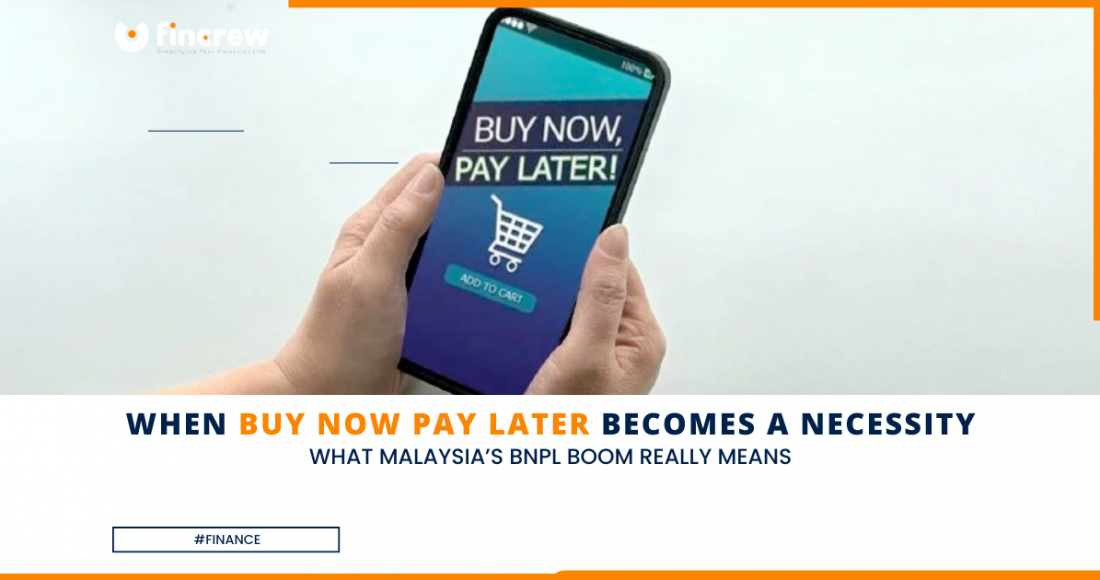

Buy Now Pay Later (BNPL) was originally marketed as a convenient payment option — a flexible alternative to credit cards that allowed consumers to split purchases into smaller instalments.
But recent data from Malaysia’s Ministry of Finance suggests the story may be changing.
In 2025 alone, BNPL transactions in Malaysia reached RM21.3 billion across 243 million transactions, with RM4.9 billion still outstanding. At first glance, these numbers simply reflect the rapid growth of fintech services.
However, one detail stands out.
More than 70% of BNPL users in Malaysia come from the B40 income group.
That statistic raises an important question:
Is BNPL still about convenience — or is it becoming a financial lifeline?
The RM91 Transaction That Reveals a Bigger Story
One of the most telling numbers in the BNPL discussion is the average transaction size: RM91.
This is not the typical profile of discretionary spending such as gadgets, luxury items or travel.
Instead, the majority of BNPL usage in Malaysia goes toward everyday essentials, including:
- Food and groceries
- Transport
- Basic services
- Small household expenses
When short-term credit is consistently used for basic living costs, it often signals something deeper — cash flow pressure within households.
BNPL in this context functions less like a lifestyle payment option and more like a short-term financial buffer.
Why BNPL Appeals to Lower-Income Households
For many B40 households, access to traditional credit remains limited.
Credit cards typically require:
- Minimum income thresholds
- Stable employment records
- Formal documentation
- Credit history checks
BNPL platforms, on the other hand, offer:
- Instant approvals
- Minimal paperwork
- Integration with e-commerce platforms
- Smaller repayment amounts
This accessibility has made BNPL one of the fastest-growing forms of consumer credit in Malaysia.
For someone facing a temporary cash shortfall, being able to split a RM100 purchase into smaller payments can feel manageable.
But convenience can quickly turn into reliance if used repeatedly.
The Hidden Cost Behind “Interest-Free” Credit
BNPL products are often marketed as interest-free, which creates the perception that they are cheaper than traditional loans or credit cards.
However, the cost structure can change when payments are missed.
Typical charges may include:
- Late payment fees
- Processing charges
- Reactivation fees
Because BNPL transactions are usually small, these fixed fees can represent a high effective cost relative to the original purchase.
For example, a late fee applied to a RM91 grocery purchase can significantly increase the total repayment amount.
This dynamic sometimes creates what economists call a “poverty premium” — where lower-income users end up paying proportionally more when mistakes happen.
The Risk of Expanding Credit Limits
Another growing concern is how BNPL credit limits expand automatically.
Some users report that their spending limits increased significantly over time without actively requesting it.
While this may seem harmless for higher-income consumers, the implications are different for households with tight budgets.
Increasing credit limits can:
- Encourage higher spending
- Create larger repayment obligations
- Expand financial exposure without income growth
In digital financial systems driven by algorithms, credit expansion can happen quietly — making financial discipline even more important.
Why BNPL Default Rates Remain Low
Interestingly, despite concerns about overuse, BNPL default rates in Malaysia remain relatively low.
According to recent data:
- Overdue BNPL balances represent about 3.3% of total lending
- This equals roughly RM160 million in overdue payments
At first glance, this suggests the system is functioning well.
However, behavioural finance offers another explanation.
Unlike credit cards, BNPL platforms typically freeze accounts immediately after missed payments.
This “hard stop” forces users to settle outstanding balances before they can continue using the service.
While this helps prevent long-term debt accumulation, it can also create strong pressure to prioritise BNPL repayments over other financial obligations.
BNPL Reflects a Larger Economic Reality
It is important to recognise that BNPL did not create Malaysia’s cost-of-living challenges.
Instead, it reflects them.
Rising living costs, stagnant wage growth, and uneven access to traditional credit have all contributed to households relying on short-term payment solutions.
In many cases, BNPL functions as a temporary patch for everyday financial gaps.
When the average transaction is only RM91 and the majority of users come from the B40 group, BNPL becomes less about convenience and more about financial resilience.
The Real Question Moving Forward
The debate around BNPL should not simply focus on whether the product should exist.
Digital credit tools can provide real benefits, especially for individuals excluded from traditional banking services.
The more important questions are:
- Are affordability checks strong enough?
- Are fees clearly communicated?
- Are credit limits aligned with repayment ability?
- Are financial literacy efforts keeping pace with fintech growth?
If BNPL is becoming a core financial tool for lower-income households, its safeguards must evolve accordingly.
Because while instalment payments can ease short-term pressure, they cannot solve the deeper economic challenges that created the need for them in the first place.